The Development Gap Undermining the AI Workforce
The roles most affected by AI are often the least supported in adapting to it.
Mentions of training in U.S. job postings have more than doubled in recent years, rising from 3.4% in 2018 to 8.1% in 2025. But that growth is uneven. Most of those opportunities are concentrated in lower-wage, lower-education, and lower-exposure roles.
Meanwhile, the roles undergoing the most change are the least supported in keeping up.
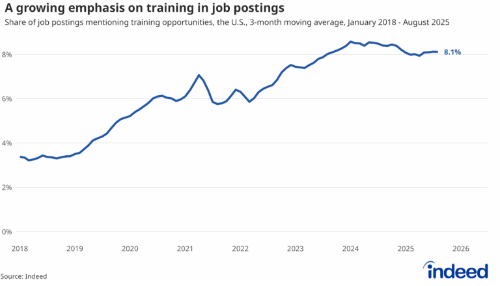
Employer-provided training has become more visible in recent years, rising from 3.4% of job postings in 2018 to 8.1% in 2025 – a 2.4x increase over eight years.
Source: Indeed Hiring Lab, 2025. Source: Indeed Hiring Labs Oct 2025
The result is a growing disconnect. The work is evolving rapidly, but the people responsible for it are expected to keep up on their own.
The Problem Isn’t Skills. It’s How Capability Is Built
Most organizations are advancing their systems faster than they are developing the people behind them.
They invest heavily in AI tools, platforms, and infrastructure, but far less in how individuals build the judgment, context, and decision-making ability required to operate within those systems.
Traditional learning models were built for stability. Learn a tool, apply it over time, revisit when necessary. That model no longer holds.
Today’s environments require continuous adjustment, deeper context, and the ability to operate across interconnected systems. Knowing how to use AI is not enough. The challenge is understanding how to operate within it.
Where Traditional Models Break Down
The distribution of training tells a clear story. Development opportunities are increasing, but not where they matter most.
High-exposure technical roles — the ones shaping how AI is built and deployed — often lack structured pathways for learning and growth.
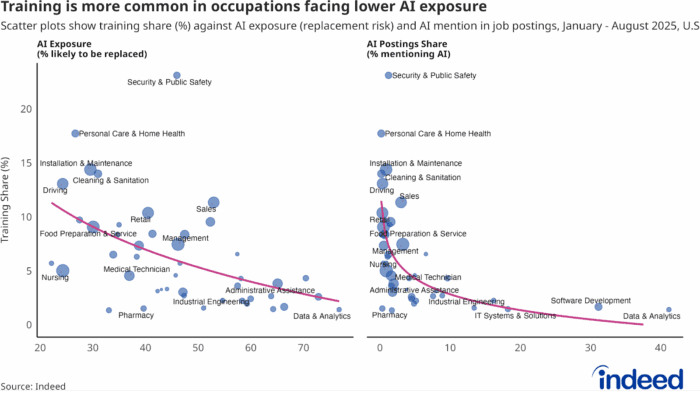
Training opportunities decline as AI exposure and adoption increase — meaning the workers most affected by AI transformation often receive the least structured development. Source: Indeed Hiring Lab, 2025.
At the same time, entry-level opportunities are shrinking, and experience requirements continue to rise.
This creates a compounding issue:
- Fewer opportunities to gain hands-on experience
- Higher expectations for prior experience
- Less structured development in the roles that need it most
Historically, early-career professionals developed through repetition. Debugging, testing, and iteration built both skill and judgment. As automation removes many of those tasks, that pathway is disappearing.
What remains is a gap between expectation and preparation. Many learning models still focus on execution rather than understanding, producing individuals who can use tools but not those who can navigate complex systems or guide outcomes when conditions change.
Rethinking How Capability Is Developed
Closing this gap does not require more training. It requires a different approach to how capability is built.
Work has shifted from task execution to system-level operation. To keep pace, development must reflect that shift.
At Uptime xAI, the focus is on building the ability to operate inside complex, AI-native environments.
That means developing judgment under uncertainty, not just familiarity with tools. It means learning how to interpret incomplete signals, navigate interdependencies, and make decisions when outcomes are not predefined.
Capability is built through exposure to real conditions, where systems behave unpredictably and decisions carry consequences.
In practice, this means:
- Learning is continuous and evolves alongside the systems themselves
- Development is grounded in real operating conditions, not isolated tools
- Individuals are trained to think in systems, not tasks
- Human judgment and machine capability are developed together
- Reliability, governance, and performance are built in from the start
This is how capability becomes durable.
The Multiplier Effect of Prepared Teams
When capability develops at the pace of technology, the impact compounds.
Organizations move faster not by adding more people, but by increasing what their teams are able to handle. Teams operate with greater clarity, make better decisions, and adapt more effectively as conditions change.
This is what enables organizations to translate AI from experimentation into sustained performance.
Building the Workforce That Keeps Up
Every advancement in AI still depends on people. The ones designing systems, guiding models, and ensuring outcomes remain reliable and accountable.
Technology accelerates what is possible. People determine what is sustainable.
The organizations that lead will not simply adopt faster. They will build teams that can operate effectively as environments continue to evolve.
Because the future is not defined by access to technology.
It is defined by the ability to operate within it.